

Hello there,
This week’s Quest of Fire Friday is part of one of two in a series on two key locations in the Lowlands that were featured from the very beginning of The Gathering Dark: Black River and Bracken. The latter being better recognized as Brackenburgh as of the two it survived into the Modern Era and grew to become one of the most important cities of the Northwestern Lowlands. Both villages appear or are alluded to repeatedly throughout the series. It would be a bit spoiler heavy to explain those instances and how each village figures into the series. I can’t really even go into thematic things on with each. What I can, however, is give you a thorough picture of each that didn’t fit into any of the entries in Quest of Fire. If you’ve read any of the books in the series and have questions about either city from your reading, feel free to send those my way. And I hope you enjoy the extra insights into each village and the character, so-to-speak, of each village and how they therefore fit into Quest of Fire and The Gathering Dark in particular:
Black River
LOCATION: Walhonde County, Libertias
POPULATION: 117 (as of Daraleath 22, 1605 Middle Era)
FIRST APPEARED IN: The Gathering Dark, Chapter 1
IMPORTANT SITES:
- Knight Hall
- Anargen’s home
- Seren’s home
- Glewdyn’s smithy
HISTORY:
Middle Era:
Black River began as a collection of cabins built by Emeral settlers who traveled to the region shortly after Libertias declared its independence from Ecthelowall. The island nation Emeral, having been conquered and assimilated into Ectheowall’s holdings decades before, had many citizens unhappy with their lot eager to escape to the new refuge just across the Imermere Channel.
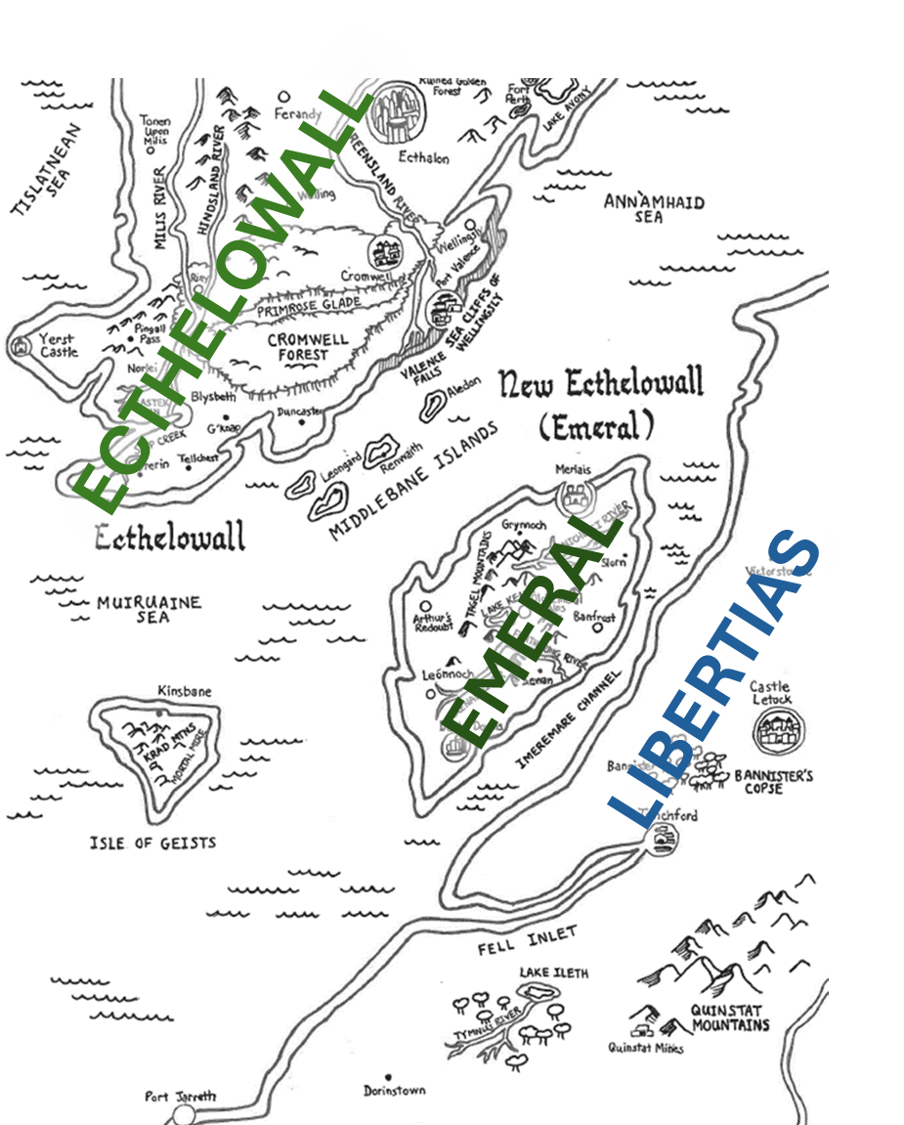
For centuries prior, nomadic wanderers passed through the region scavenging berries and hunting game. The Emeralan settlers quickly found themselves battling against those wanderers during a particularly dry summer when it became apparent food would be scarce in the nomads’ winter grounds. Desperate, the settlers sent an appeal to the ruler of Libertias’s nearby Aonar County to request aid. The messengers were well received in Aonar’s capital Einwis, with Count Peter II quickly dispatching two dozen of his best soldiers.
A short decisive series of skirmishes with the nomadic invaders took place, before the Emeralan settlers and the lands they claimed were secured and incorporated into Aonar County. Shortly after, Count Peter II assigned the settlements a reeve and requested the Knights of Light send Knights Errant to establish chapter halls in the five settlements that were quickly consolidating into villages. With the raids halted, the settlers enjoyed a period of tranquil life in the wooded area. Earthen roads were established between each burgeoning village and one site became the focus of the reeve’s activities and the defacto chief amongst the settlements, called West Haven. The first iteration of the Knight Hall seen in The Gathering Dark was built during this time and a start was made on its modest library collections, mainly from parchment scraps and tomes carried over from Emeral.
When iron and coal were found in the mountains to the west, a flurry of new settlers, mainly of Ecthel descent, moved to the area. With the influx of new townspeople and the increasing importance of mining in the area, conflicts began to pop up. The now well established and mostly agrarian Emeralans resented the incursions and superiority of the Ecthelish ancestry mine owners who paid nominal wages for intense labor exacted from them. The conflict led to a formal plea to the Knight Errant in West Haven, Sir Irwin Young, to act on their behalf. Strongly convicted of the need to protect the poor and vulnerable, and with the majority of those impacted being Knights under his charge, Sir Young beseeched the newly ascended Count Hoult of Aonar to intervene in the disputes and provide protections for the people there. Young didn’t know that the new count was already being pressed to expand the mining operations and make Aonar a central source of steel to arm and defend the still young Libertias. Many of Aonar’s cities had benefitted from the sudden influx of wealth and to a degree so had the formerly Emeralan villages. Count Hoult therefore found the petition nonsensical and delivered a harsh dismissal of Sir Young’s request. Undeterred, Young sent word to the Defender of the Northern Realm at the time, an Albaron named Sir Gawnwise and requested he take up the matter. By the time the Knight Defender’s letter to the preeminent Libertian count in Kirke made it, things had deteriorated significantly.
The expanded size and scope of mining operations in the region, called Walhonde, around what was now named the Black River (named such for the coal all along the riverbed), led to reeves being assigned to each major settlement: West Haven, Raresbruck, Black River, Abaross, and Ironhold. Black River’s reeve was cruel and greedy. He accepted a bribe to look the other way when Sir Young’s child was kidnapped and put to work in the mines of Ironhold. While Sir Young was absent from affairs trying to find his son, another crisis in the form an outbreak of a strange illness hit the towns along the Black River. Dozens were violently ill and both Ecthel and Emeralan descended citizens were impacted. It was discovered that the source of illness was contamination of the drinking water in Walhonde through the attempt to mine the coal directly from the Black River. Outraged, mobs formed and ransacked the outposts of each town’s respective reeve, before coalescing and turning towards Einwis.
On the night of Blomsen 29, 1501 Middle Era, Sir Young located his son only to discover the child had died in an accident in the mine the day prior. Heartbroken, he rode back to Black River to find it mostly deserted. Young was able to glean enough from those left behind to realize what the mob was planning—to sack Einwis and overthrow Count Hoult.
Riding furiously after the mob, Sir Young caught up to the group a few miles outside Einwis. He pleaded with those at the head of the mob to not plunge Walhonde and Aonar into a fresh cycle of violence. His impassioned plea fell on deaf ears until he pointed out that the High King taught his servants to seek to make peace. And though he had lost his son to the avarice of the Count and those who served him, he would not raise his spiritsword against them. Many of those hearing were Knights and seared through the heart by his words. They turned back with Sir Young leaving a much-diminished force to face the Count’s army which was already amassing for a devastating counter-offensive.
The mob disbanded, but Count Hoult pressed for his riders to pursue and harangue the retreating citizens of Walhonde. Martial law was imposed in all five towns. Sir Young, while not an advocate of violence, had no desire to leave everyone in suffering. Gathering as many as would come, he rode out, breaking through the ranks of Aonar County’s soldiers guarding the towns to lead a band of Knights and others to the unsettled east. He freely welcomed any to join them and a trickle of others were able to escape Count Hoult’s despotic hold to reach a settlement on what had been declared the Knight’s River by those following Sir Young.
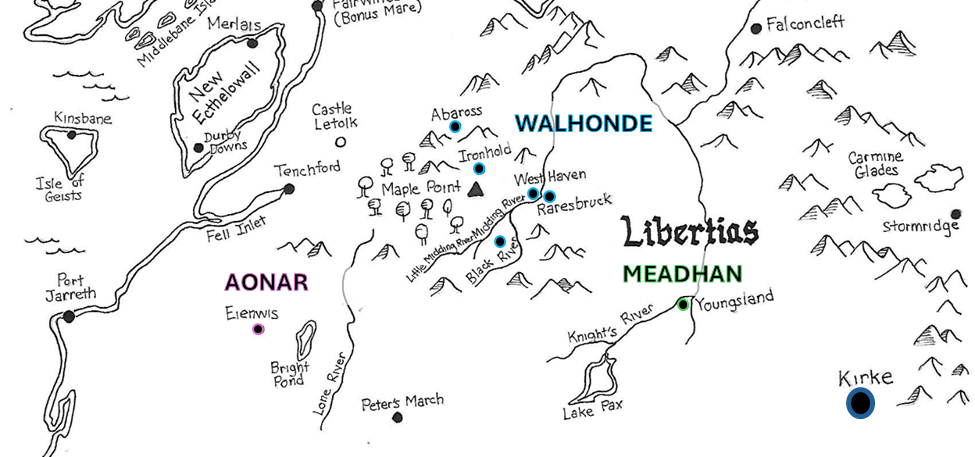
Count Hoult gathered his forces and marched on Sir Young’s position. Impossibly outnumbered, Sir Young tried to retreat further east, but his group was outmaneuvered and surrounded by the shore of a nearby lake. After quickly building some defensive earthen works and ramparts, the group settled in to await Count Hoult’s arrival. Once again, Sir Young insisted there was no need for bloodshed and offered to peacefully surrender himself in exchange for the pardon of those with him.
Hoult agreed to the terms, but as soon Sir Young was in custody, he had him brutally executed in front of those present and commanded that all those assembled be arrested and pressed into slave labor. Those who had followed Sir Young chose to heed his guidance and did not attack, nor did they surrender. All the Knights in the group formed a defensive perimeter on the earthen works, protecting the unarmed and children, shields and swords bared in defense.
The Count dismissively commanded a single company of his soldiers to attack. They were repulsed. He doubled the number and ordered again an attack be made. Once more the Aonar County’s forces were bested. After a weeks’ long siege to starve the group out failed to deliver results, Count Hoult’s patience was exhausted. For his third attack, he brought his full army to bear, leading the charge and overtaking the Knights and their defenses. But the delay afforded by the defense allowed word to reach Libertias’s capital, Kirke, where Count Hoult’s ruthlessness and corruption enraged all. The Viscount of Libertias gathered the other Counts of the fledgling nation and rode out. They caught Hoult’s army in its trek back westward—following the bodies he had left hanging from trees along the way.
Stunned by the sudden and swift attack, Count Hoult’s army crumbled. Stripped of his title and bound, he was kept in the dungeons of Kirke for the remainder of his life. His army was disbanded and a new count was appointed. It was also decided that the five mining towns should be reorganized and formed into a county unto themselves, Walhonde County.
Though this concession satisfied a large portion of those from Walhonde, some feared the reprieve from corruption and exploitation by the mine owners would be short-lived and ultimately falter in time. They petitioned for and were granted a separate county—Meadhan— founded around the settlement they had been building on the Knight’s River. They named the settlement Youngsland after the brave and compassionate Sir Young and likewise named the lake in the region Lake Pax, after the ancient word for “peace.”
In the years after, Meadhan County came to be a tranquil and bucolic refuge for those seeking a quiet and simple life. Walhonde County, unfortunately, all too quickly did fall back under corruption’s sway, particularly as the Mining Guild came together and grew to subtly dominate life there. Bittersweet songs and somber stories were crafted to give voice to the pain and quiet resilience of the mountain region. The legacy of Sir Young’s courage led to an ardent respect for the High King and the Knight Halls in Black River, West Haven, and Raresbruck came to hold places of prominence in day-to-day affairs, as reeves, while appointed afresh, were never fully trusted again. Black River’s Knight Hall was rebuilt with stone and glass, a visible display of that respect from an otherwise quiet and unassuming village in the years after.
Black River’s steady ardor for the High King caught the attention of Sir Meredoch MacCowell (Defender of the Northern Realm from 1565 – 1606 Middle Era) and under the pseudonym of Sir Cinaed was led there by the High King to take up the role of Knight Errant of Black River. There he mentored young Anargen, Caeserus, Terrillian, and Bertinand until a messenger from the far-flung land of Ordumair arrived and beckoned him come with his charges on task that ultimately was an integral part of the Quest of Fire.



Leave a Reply